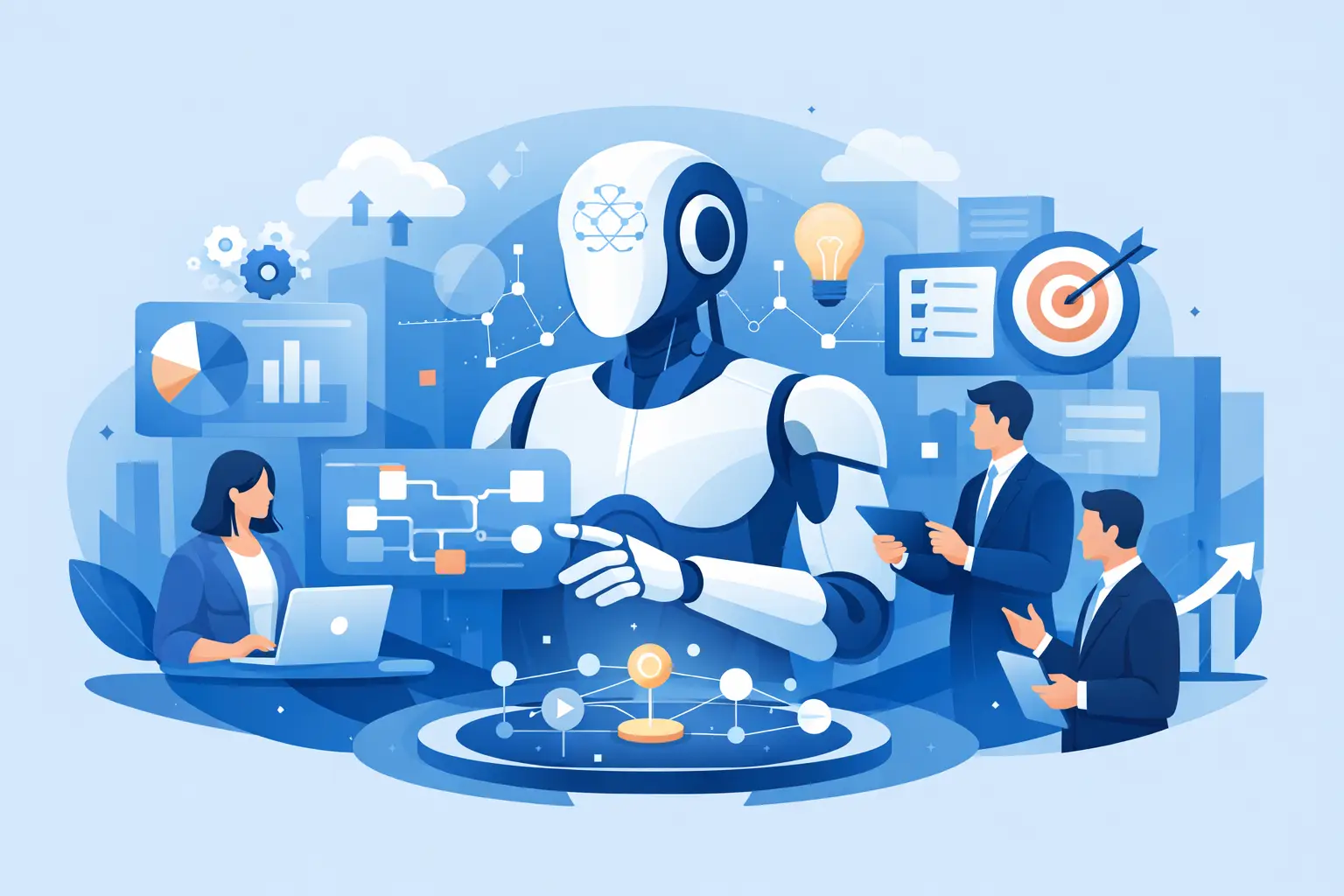
A support team should not have to search five systems to answer a customer question. A procurement manager should not spend hours chasing approvals that follow predictable rules. These are the practical problems AI agent development is beginning to solve – not by replacing every person in a workflow, but by giving software the ability to understand a goal, take approved actions, and escalate when judgment is required.
For founders and operations leaders, the opportunity is significant. An effective AI agent can reduce repetitive coordination, make business knowledge easier to use, and keep work moving across disconnected tools. But an agent that is rushed into production can create new risks: incorrect updates, poor decisions based on incomplete data, security gaps, and frustrated users. The difference comes down to selecting the right use case, designing clear controls, and building for reliable execution from the first release.
What AI Agent Development Means in Practice
AI agent development is the process of building software that can pursue a defined business objective using language models, company data, business rules, and connected tools. Unlike a standard chatbot that primarily answers questions, an agent can reason through a task, choose from permitted actions, call systems through APIs, verify results, and report back to a user.
Consider a service operations agent. It may receive a request to update an account, retrieve relevant order history from a CRM, check policy rules, prepare a response, and create a follow-up task for a human specialist. The agent is useful because it coordinates steps that usually require switching between applications and interpreting unstructured information.
That does not mean every workflow needs an autonomous agent. If a task follows a fixed sequence with stable inputs, conventional workflow automation is often faster, less expensive, and easier to audit. Agents become valuable when work includes variable requests, documents, exceptions, or decisions that benefit from contextual understanding.
The strongest projects combine both approaches. The agent handles interpretation and task planning, while deterministic automation handles calculations, approvals, record updates, and other actions where predictability matters most.
Start With a Workflow, Not a Model
Many AI initiatives start with a model demonstration. A better starting point is a workflow that has measurable friction. Look for processes where employees repeatedly gather information, classify requests, draft content, route work, or reconcile data between systems.
A useful candidate has three characteristics: it occurs frequently, it has a clear business outcome, and it can be constrained by policies or human approval. For example, an agent that triages inbound vendor requests may reduce response time and prevent missed opportunities. An agent that autonomously approves high-value payments without reliable controls is a much riskier first project.
Before development begins, define the baseline. Measure current handling time, error rates, backlog volume, escalation frequency, and customer impact. These numbers make the business case clearer and prevent teams from judging success only by whether the agent produces convincing text.
You should also map the workflow’s exceptions. What happens when a customer record is missing? Which requests require manager approval? What information must never be exposed? In most real deployments, exceptions are where the true product requirements appear.
The Building Blocks of a Reliable Agent
An agent is more than a prompt connected to a language model. Production-grade systems need a deliberate architecture that separates reasoning, data access, action execution, and oversight.
The instruction layer defines the agent’s role, boundaries, priorities, and response format. It should tell the agent what it may do, what it must not do, and when to stop and request help. Clear instructions reduce inconsistent behavior, but they are not a complete safety mechanism.
The knowledge layer gives the agent access to approved information, such as policies, product catalogs, internal documentation, account data, or operational records. This data must be current, permission-aware, and traceable. An agent that references outdated policies can create costly errors even if its reasoning is otherwise sound.
The action layer connects the agent to systems that matter: CRM platforms, ERP software, ticketing tools, scheduling systems, payment services, or custom internal applications. Each integration should use narrow permissions. A customer service agent may be allowed to create a support ticket or draft a refund request, while a manager or a separate rules engine confirms the final transaction.
Finally, the control layer records what the agent saw, what it decided, which tools it used, and what happened next. Logs, alerts, approval gates, rate limits, and fallback paths make the system manageable after launch. Without this layer, teams can struggle to investigate failures or improve performance.
Build AI Agents Around Trust Boundaries
The question is not whether an agent can complete a task. The question is whether it can complete the task safely at the level of autonomy you allow.
A practical model is to assign different levels of authority. At the lowest level, the agent summarizes information or drafts a recommendation. Next, it can prepare actions for human approval. At a higher level, it can take low-risk actions automatically, such as categorizing a ticket, scheduling an appointment, or sending a status update. High-impact actions involving money, legal commitments, sensitive health information, or irreversible data changes should have stricter validation and approval rules.
This is where human-in-the-loop design becomes a business advantage rather than a limitation. Early releases should make it easy for employees to review recommendations, correct outputs, and flag edge cases. Their feedback reveals whether the agent needs better data, clearer policies, new integrations, or a different workflow design.
Security must be designed at the same time. Use role-based access, data minimization, encryption, environment separation, and audit trails. Test for prompt injection, unauthorized data retrieval, incorrect tool use, and attempts to bypass approval rules. For regulated sectors such as healthcare, finance, and education, compliance requirements should shape the architecture from day one rather than become a late-stage checklist.
A Delivery Plan That Produces Useful Results
The fastest path is usually a focused MVP, not a broad enterprise-wide agent program. Choose one workflow, one user group, and a limited set of connected systems. The first release should prove that the agent improves a measurable outcome while operating within clear boundaries.
During discovery, translate the business process into user stories, decision rules, integrations, data requirements, and acceptance criteria. This stage is especially valuable for nontechnical stakeholders because it turns an ambitious idea into visible delivery milestones.
During design and development, create realistic test scenarios from actual work, including ambiguous requests and failure conditions. Testing an agent only with clean, expected inputs creates false confidence. The test set should include incomplete records, conflicting instructions, unusual phrasing, permission errors, and requests that must be escalated.
After launch, monitor both technical and business signals. Track task completion, tool failures, response quality, handoff rates, user corrections, latency, cost per task, and operational outcomes. An agent that handles more requests but creates more rework is not delivering value. Ongoing tuning is part of the product, whether that means updating knowledge sources, refining instructions, improving retrieval, or adjusting approval thresholds.
Common Mistakes That Slow Down AI Agent Projects
One common mistake is giving an agent access to too many systems too early. Broad access makes demonstrations look impressive, but it expands security exposure and makes failures harder to diagnose. Start with the smallest useful action set, then extend permissions based on proven performance.
Another is treating agent output as fact. Language models can produce plausible but incorrect answers. Ground responses in verified data, require citations or source references within the application where appropriate, and use validation rules before consequential actions occur.
Teams also underestimate change management. Employees need to know what the agent does, where its limits are, and how to report issues. If users see it as an opaque replacement effort, adoption will suffer. If they see it removing repetitive work while preserving their authority over exceptions, they are more likely to help improve it.
Finally, avoid measuring success by novelty. The best agent may be invisible to customers because it shortens a queue, prevents an error, or helps an employee make a better decision in less time. Those outcomes are more valuable than a flashy interface with no operational impact.
Choose a Partner That Can Deliver Beyond the Prototype
AI agents must live inside real products and operational environments. That requires product thinking, user experience design, backend engineering, integrations, quality assurance, security practices, and post-launch support alongside AI expertise. A prototype can demonstrate potential, but production delivery determines whether the solution becomes part of daily work.
Xornor Technologies helps businesses turn process challenges into production-ready software, from MVP planning through integrations, testing, feature releases, and ongoing support. The right engagement starts by identifying a workflow where faster decisions and better execution will create visible value.
The most useful next step is simple: select one process your team repeats every day, document where work gets delayed, and define what a safe first action would look like. That is where a practical agent begins. Get in Touch when you are ready to build it with clear ownership and measurable outcomes.