A customer inquiry arrives after business hours. A support agent copies details into three systems the next morning. An operations manager follows up manually, while a sales opportunity sits untouched. None of these tasks is difficult, but together they create delay, inconsistency, and avoidable cost.
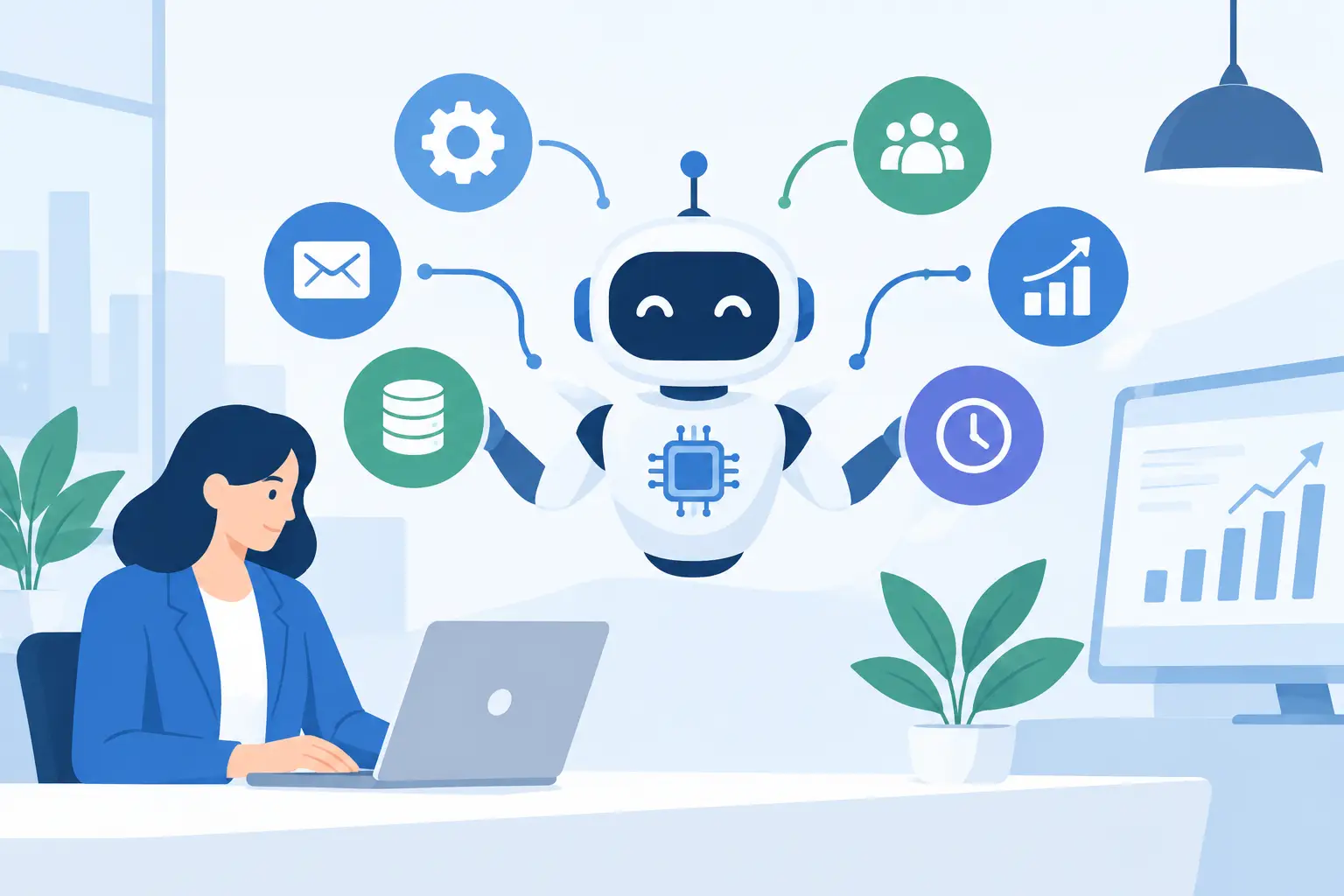
AI automation services address this problem by connecting business workflows with intelligent decision-making. The goal is not to add AI because it is fashionable. The goal is to remove repetitive effort, route work to the right people, surface useful information faster, and give teams more time for work that requires judgment.
For founders and operations leaders, the opportunity is substantial. But successful automation depends on choosing the right processes, defining clear guardrails, and building technology that fits how the business actually operates.
What AI Automation Services Should Deliver
Traditional automation follows fixed rules. When a form is submitted, create a record. When an invoice is approved, notify finance. These workflows remain valuable, especially when the process is predictable.
AI extends automation into work that involves unstructured information or limited interpretation. It can classify incoming requests, extract data from documents, summarize support conversations, recommend next actions, and draft responses for human review. It can also recognize patterns across large volumes of operational data that would take a team hours to process manually.
The strongest AI automation services combine both approaches. A reliable workflow may use rules for approvals and compliance steps, then apply AI where interpretation creates a meaningful advantage. For example, an AI model can categorize a customer email, while deterministic rules ensure that billing complaints always reach the appropriate team within a defined service window.
That distinction matters. AI should not be asked to make every decision. In high-stakes workflows involving patient information, financial approvals, contracts, or sensitive employee data, human oversight and clear escalation paths are essential.
Where AI Automation Creates Business Value
The best starting point is usually not the most advanced use case. It is the process that is high-volume, repetitive, measurable, and frustrating for the people responsible for it.
In customer support, automation can triage tickets by urgency, detect common issues, prepare response drafts, and route complex cases to experienced agents. The result is faster first-response times without turning customer service into an impersonal system.
In sales and marketing operations, AI can qualify inbound leads using defined criteria, enrich records, summarize discovery calls, and trigger follow-up tasks. Teams still need to set the qualification logic and review edge cases, but fewer prospects are lost because a handoff was delayed.
For supply chain and field operations, AI can extract information from purchase orders, flag exceptions, predict potential delays from available data, and create task queues for coordinators. In healthcare administration, it can support intake workflows, document processing, appointment communications, and internal knowledge retrieval, subject to privacy and regulatory requirements.
Product and engineering teams can use automation to organize bug reports, identify duplicate issues, summarize user feedback, and notify the right owners when a production event needs attention. These are practical gains that improve execution without replacing accountability.
Start With Workflow Discovery, Not a Tool
Many automation initiatives stall because the team begins with a platform demo rather than the operational problem. A tool may be capable, but capability alone does not create a dependable process.
A better approach begins by mapping the current workflow. Identify where work starts, which systems hold the needed data, who makes decisions, where exceptions occur, and what a successful outcome looks like. This often exposes process issues that should be fixed before automation is introduced.
Consider an onboarding workflow for a B2B service business. The objective may sound simple: move a signed customer into implementation. In practice, the process may involve contract details, payment confirmation, account provisioning, kickoff scheduling, internal ownership, and customer communications. If those handoffs are unclear, automating them will only move confusion faster.
A useful discovery phase should answer three questions. First, what manual effort can be removed or reduced? Second, where can AI make a recommendation rather than a final decision? Third, which metrics will prove that the new workflow is working?
Metrics may include turnaround time, error rate, ticket resolution time, conversion rate, cost per transaction, or the number of hours recovered each week. Without a baseline, it is difficult to distinguish real improvement from a system that simply looks more sophisticated.
Build for Accuracy, Control, and Change
An AI workflow is only as reliable as the information, instructions, and integrations behind it. If customer records are inconsistent or approval rules are undocumented, the solution needs to account for that reality.
This is why custom implementation is often more effective than connecting generic tools with minimal configuration. A well-designed solution can integrate with the CRM, ERP, help desk, learning platform, inventory system, or proprietary database already used by the business. It can apply role-based access, audit logs, validation rules, and exception handling that match the organization’s requirements.
Prompt design and model selection also matter, but they are not the whole project. The AI needs clear context, defined outputs, limits on what it can do, and a way to hand work back to a person when confidence is low. For customer-facing use cases, response quality should be tested across realistic scenarios, including ambiguous requests and unusual cases.
Data security deserves the same discipline. Businesses should know what data is sent to an AI service, how it is retained, who can access it, and whether the workflow meets contractual or regulatory obligations. A lower-cost solution is not a good investment if it creates exposure around confidential data or produces decisions no one can explain.
Choosing the Right Delivery Model
Some organizations need a focused automation project: one workflow, a defined integration, and a fast release. Others need a broader program that modernizes several connected processes over time. The right model depends on the business goal, internal technical capacity, and how much the workflow is expected to evolve.
A short discovery and MVP phase is often the practical choice when the use case is new. It allows the team to validate data access, test user adoption, and measure early outcomes before investing in a larger rollout. Once the workflow proves its value, it can be expanded with stronger reporting, additional integrations, and more advanced AI capabilities.
For businesses with ongoing product needs, a dedicated development team can provide continuity. The same engineers and product specialists can improve the automation after launch, respond to changing requirements, and keep the underlying software maintainable as systems and policies change.
Xornor Technologies helps businesses move from operational requirements to production-ready AI-enabled workflows, with product strategy, custom development, quality assurance, and post-launch support aligned around measurable outcomes.
Common Mistakes That Limit Results
The first mistake is automating a broken process without simplifying it. If staff members use workarounds because the official process is unclear, those issues must be addressed first.
The second is treating AI output as unquestionable. Models can misunderstand context, generate incomplete responses, or make incorrect assumptions. Human review is especially valuable when decisions affect customers, revenue, compliance, or safety.
The third is launching without ownership. Every automated workflow needs someone responsible for its performance, exceptions, and ongoing improvement. Automation is not a set-it-and-forget-it asset. Business rules change, source systems change, and users discover edge cases after release.
Finally, organizations sometimes focus only on cost reduction. Lower manual effort is valuable, but better service, faster decisions, fewer errors, and improved employee capacity can create equal or greater returns.
A Practical Path to AI-Enabled Operations
The most effective AI automation programs start small enough to control and meaningful enough to measure. Choose a workflow with visible friction, establish the baseline, involve the people who perform the work, and define the moments where human judgment must remain in the loop.
From there, build an MVP that connects to the systems your team already depends on. Test it with real scenarios, monitor results closely, and improve the workflow before expanding it. This approach creates confidence internally and prevents a promising idea from becoming another disconnected tool.
The businesses that gain the most from AI automation are not necessarily the ones using the most AI. They are the ones using it with clear purpose, reliable engineering, and operational ownership. If a critical process is holding your team back, Get in Touch and turn that friction into a workflow built to move faster.