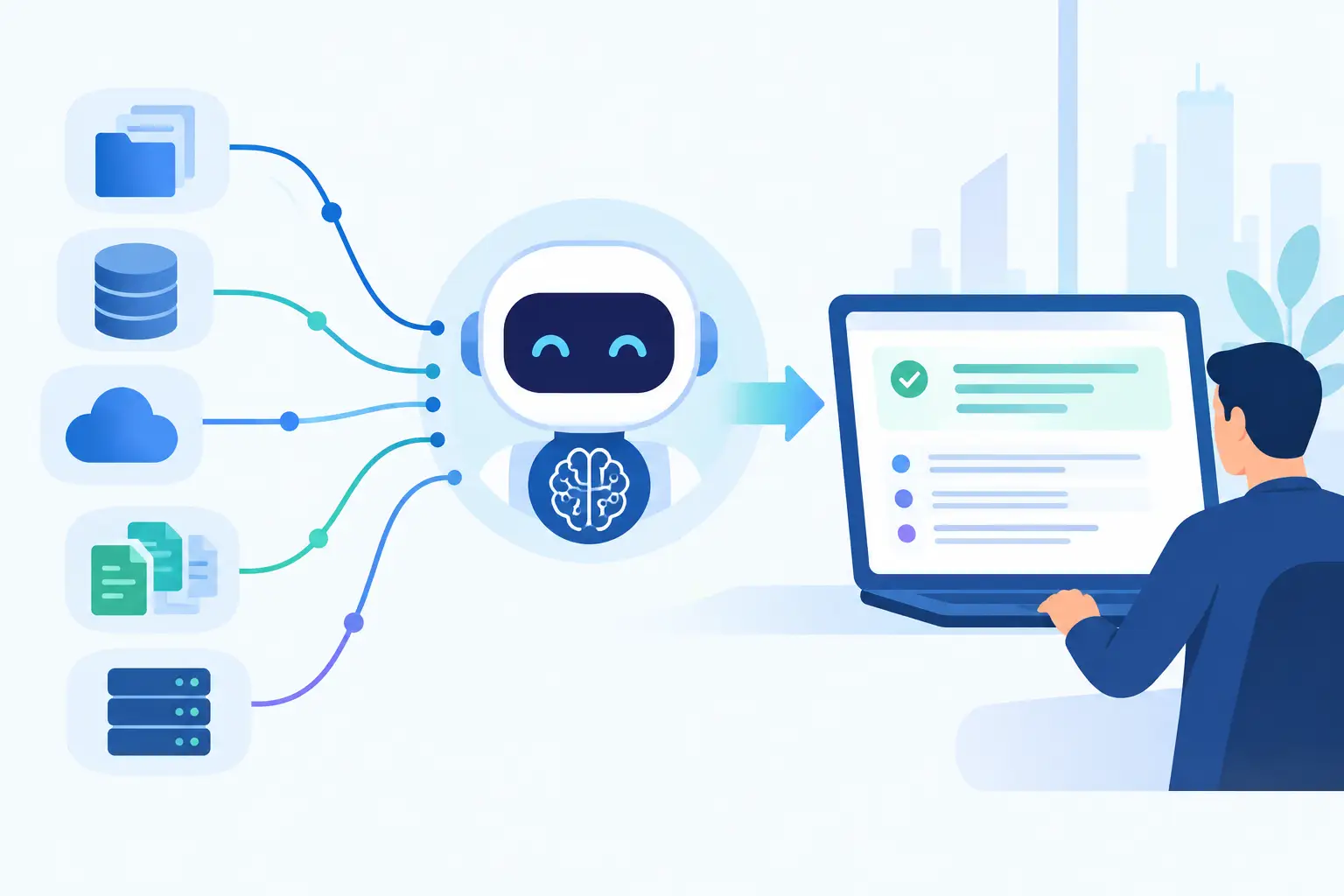
A customer support assistant that confidently invents a refund policy does more than create a poor user experience. It creates operational risk. RAG, short for retrieval-augmented generation, gives AI applications a practical way to answer from approved business knowledge rather than relying only on what a language model learned during training.
For product leaders and operations teams, the appeal is straightforward: AI can use current product documentation, support articles, contracts, internal policies, technical manuals, and structured business data without retraining a model every time information changes. But successful RAG is not simply a chatbot connected to a folder of PDFs. It is an engineering system that requires disciplined data preparation, retrieval design, security controls, and measurement.
What RAG Means for an Enterprise AI Product
A traditional large language model generates an answer based on patterns in its training data and the prompt it receives. That can be useful for drafting, classification, brainstorming, and many other tasks. It is less reliable when the question depends on proprietary, changing, or highly specific information.
RAG adds a retrieval step before generation. When a user asks a question, the application searches a selected knowledge base for relevant content. The most useful passages are provided to the model as context, and the model creates an answer grounded in those sources.
Consider an AI assistant for a healthcare operations platform. A user may ask how a referral should be routed under a particular payer rule. Instead of guessing, the assistant can retrieve the current internal workflow, payer documentation, and approved exception criteria. The response becomes more useful because it is tied to the organization’s actual process.
This approach does not make AI automatically accurate. It gives the application better evidence to work from. The quality of the result still depends on whether the right information was indexed, retrieved, and presented clearly to the model.
Why Businesses Are Adopting RAG
The strongest RAG use cases are usually not broad public chat experiences. They are focused workflows where employees or customers repeatedly need answers buried across systems, documents, and team knowledge.
A digital commerce business can help support agents locate product specifications, warranty terms, shipping rules, and order-management procedures. An EdTech company can power a learner or administrator assistant using course policies, platform guidance, and program materials. A supply chain team can surface approved operating procedures when shipments are delayed or inventory exceptions occur.
The business case typically comes from three outcomes: faster decisions, reduced time spent searching for information, and more consistent execution. In high-volume service operations, even a small reduction in average handling time can be meaningful. In regulated or technical environments, source-backed answers can also reduce the risk of employees acting on outdated guidance.
RAG is especially valuable when knowledge changes frequently. Product release notes, pricing rules, service procedures, and compliance documents can be updated in the knowledge source and re-indexed. That is often faster and less expensive than model fine-tuning.
The RAG Architecture That Determines Quality
Enterprise teams should view RAG as a product capability, not a single AI feature. Its core architecture includes content ingestion, indexing, retrieval, response generation, and monitoring. Weakness in any one layer can undermine the experience.
Prepare Knowledge Before You Index It
Most business content was not created for AI retrieval. PDFs may contain broken formatting, duplicated sections, scanned pages, unclear headings, and obsolete versions. Shared drives often include draft documents alongside approved policies. If these inputs are indexed without governance, the application can retrieve conflicting or unreliable material.
Content preparation should identify the source owner, document version, effective date, audience, permission level, and status. Teams should remove or clearly label retired content. For scanned documents, optical character recognition and quality checks are necessary before indexing.
The way content is divided also matters. Long documents are usually split into smaller chunks so retrieval can locate the precise section relevant to a question. Chunks that are too large can dilute relevance. Chunks that are too small can lose the context needed to interpret a policy or procedure. The right balance depends on the document type and the questions users need to ask.
Retrieve for Meaning, Not Just Keywords
Modern RAG systems often use vector search, which finds content with similar meaning rather than matching only exact words. That helps when employees use different language from the original document. A question about canceling an order may still find content labeled “order reversal procedure.”
Keyword search remains useful, particularly for product codes, error messages, invoice numbers, legal clauses, and exact terminology. In many enterprise applications, hybrid retrieval combines semantic and keyword search to improve coverage.
Results should then be ranked again using the user’s question, content quality signals, recency, and business rules. A current, approved policy should outrank an old training presentation, even if both appear relevant. This is where implementation discipline becomes visible to users: the best answer is rarely just the closest text match.
Generate Answers With Clear Boundaries
The model should be instructed to answer only from retrieved evidence when the use case requires high confidence. It should cite the relevant source title or section in the interface where appropriate, state uncertainty when the evidence is incomplete, and avoid filling gaps with plausible language.
A good RAG experience also knows when not to answer. If no reliable source is found, the application can direct the user to a support team, create a ticket, or ask a clarifying question. False certainty is usually more damaging than a transparent handoff.
Security and Access Control Cannot Be Added Later
Business knowledge is rarely public. Internal documentation may contain customer details, pricing terms, employee information, intellectual property, or regulated data. A RAG application must enforce permissions at retrieval time, not merely hide content after an answer is generated.
That means the system needs to understand who the user is and what they are allowed to access. A regional manager may see operating procedures for their region, while an HR document should remain available only to authorized roles. If a user cannot access a document directly, the AI should not retrieve its contents or use it to formulate an answer.
Data handling decisions also affect architecture. Teams need clarity on where documents are stored, how embeddings are created, whether prompts and outputs are retained, and what model provider controls apply. For healthcare, finance, and enterprise environments with contractual obligations, these decisions should be addressed during product design rather than after launch.
How to Measure Whether RAG Is Working
A polished chat interface can hide weak retrieval. Measure performance at two levels: whether the system found the right evidence and whether it produced a useful answer from that evidence.
Start with a test set of real questions drawn from support tickets, sales enablement requests, operational incidents, and internal search behavior. Subject matter experts should define what sources an ideal response must use and what an acceptable answer looks like. This gives the team a repeatable benchmark before exposing the feature to a wider audience.
After launch, monitor answer acceptance, escalation rates, unanswered questions, source usage, latency, and user feedback. Review failed queries regularly. Some failures point to missing content, while others reveal poor chunking, weak metadata, unclear user questions, or an overly broad retrieval scope.
It also helps to separate high-stakes workflows from low-stakes assistance. A RAG assistant can summarize onboarding guidance with relatively light review. Recommendations involving clinical decisions, legal commitments, payment approvals, or security actions need tighter guardrails, human review paths, and auditability.
Choosing Between RAG, Fine-Tuning, and Search
RAG is not the right answer for every AI requirement. If the goal is to teach a model a consistent tone, response format, or specialized classification behavior, fine-tuning may be useful. If users simply need to locate exact documents, improving enterprise search may be more cost-effective than building a conversational layer.
RAG is the stronger choice when answers must reflect changing private knowledge and explain that knowledge in natural language. It can also work alongside fine-tuning: a tuned model can follow a specific workflow or output format while RAG provides the current facts.
The decision should begin with the business task, not the technology label. Ask what users are trying to accomplish, which systems contain the trusted information, what errors would cost, and who owns the content. Those answers shape the right solution more than a generic AI roadmap.
Building a RAG Product That Teams Will Use
The most effective implementations begin with a narrow, measurable use case. Rather than connecting every company document on day one, start with a well-maintained knowledge domain such as customer support policies, technical troubleshooting, employee onboarding, or a defined operations workflow.
Build the first release around the questions users already ask. Include feedback controls, source visibility, escalation paths, and analytics from the start. Then expand based on evidence. This approach reduces risk while giving stakeholders a clear view of where AI is saving time or improving service quality.
For organizations without an in-house AI engineering team, the delivery partner must be able to handle more than model integration. The work includes product discovery, secure platform architecture, data pipelines, user experience, quality assurance, deployment, and ongoing improvement. Xornor Technologies approaches RAG as an end-to-end software capability, designed around the workflows and accountability standards that matter to the business.
A useful RAG system earns trust one answer at a time. Start with knowledge your organization can verify, give users visibility into the evidence, and improve the system where real work exposes gaps. That is how an AI assistant becomes a dependable part of operations instead of another promising tool employees stop using.