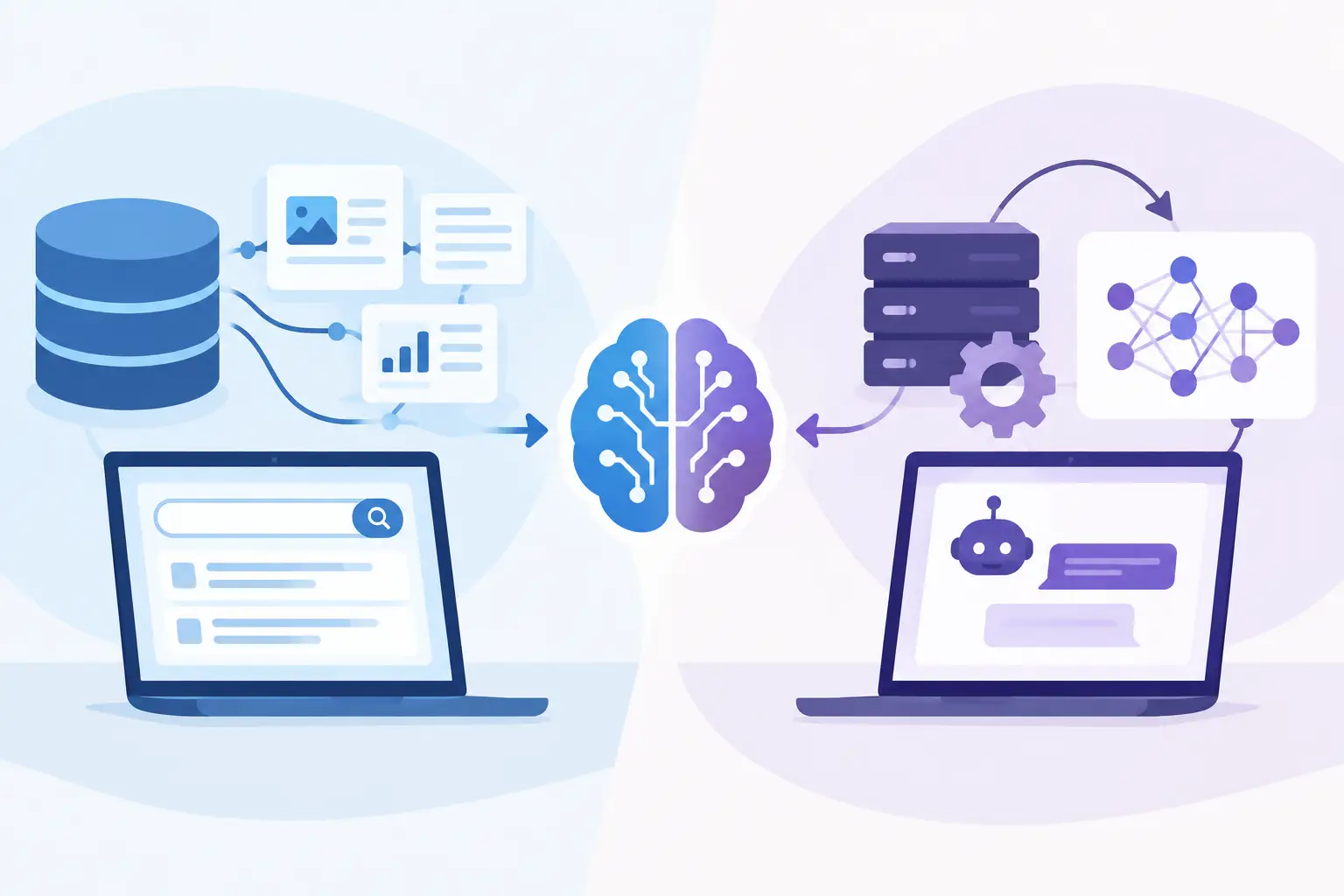
A customer asks your support assistant about a policy updated last Tuesday. An operations manager needs a workflow copilot to reference the latest SOP. A clinician-facing tool must answer only from approved care guidance. These are not simply chatbot features. They are product decisions that determine data quality, cost, maintenance effort, and user trust.
The RAG vs fine tuning decision is often framed as a technical debate. For business leaders, the practical question is simpler: does your AI product need current, traceable knowledge, or does it need to behave differently at a fundamental level? The answer may be one approach, the other, or a carefully designed combination.
What RAG Does Well
Retrieval-augmented generation, or RAG, gives a language model access to external information at the time of a user request. Before the model creates an answer, the application searches a defined knowledge source, selects the most relevant material, and supplies that context to the model.
Think of a digital commerce support assistant that searches current return policies, shipping rules, product manuals, and order-specific details. The underlying model does not need to memorize every policy. It receives the relevant policy content when it needs it.
This makes RAG especially useful when information changes frequently or when answers must be grounded in business-approved materials. In an EdTech platform, the retrieval layer can pull course content, assessment rules, and learner documentation. In supply chain operations, it can surface live procedures, vendor agreements, and exception-handling guidance. In healthcare, it can be limited to approved knowledge bases with clear permissions and review controls.
RAG also supports better operational governance. Teams can update a source document, index the new content, and make revised knowledge available without retraining the model. That is a meaningful advantage for organizations where processes, compliance requirements, pricing, or product documentation change regularly.
RAG is not just a document upload feature
A reliable RAG implementation needs more than a folder of PDFs. The system must extract and clean content, divide it into useful sections, attach metadata, generate searchable representations, retrieve relevant passages, and pass the right amount of context to the model.
Poor chunking can separate a rule from its exception. Weak metadata can make a regional policy appear in the wrong market. Retrieval that returns loosely related content can produce an answer that sounds convincing but is not useful. The application also needs permission-aware retrieval so users see only the information they are authorized to access.
For high-stakes use cases, the interface should show source references, state when supporting information is unavailable, and offer a clear route to human support. These design choices turn a generic chatbot into a product feature people can use with confidence.
When Fine Tuning Is the Better Investment
Fine tuning changes how a base model responds by training it on a curated set of examples. It is most valuable when the objective is consistent behavior, specialized output structure, or a distinct task pattern that prompting alone cannot reliably produce.
For example, a legal operations platform may need the model to classify incoming requests into an internal taxonomy and return a strict JSON structure every time. A service platform may need to transform free-form field notes into standardized job reports. A healthcare workflow tool might require a narrow, repeatable documentation format that follows carefully reviewed examples.
In these cases, fine tuning can improve consistency, reduce prompt length, and make the model better at a repeatable task. It can be a practical choice when the same behavior is performed at high volume and there are enough high-quality examples to teach that behavior.
Fine tuning is not a shortcut for keeping business knowledge current. If a company fine-tunes a model on a product catalog, policy manual, or employee handbook, each important update may require new training data, evaluation, and another training cycle. That creates an avoidable maintenance burden when RAG could retrieve the latest material directly.
Fine tuning also requires discipline around data quality. Training on inconsistent, outdated, or poorly labeled examples will reproduce those problems at scale. Before investing, teams should confirm that the task is stable, examples are representative, and success can be measured against a meaningful test set.
RAG vs Fine Tuning: The Decision Framework
The most productive way to compare RAG and fine tuning is to start with the product requirement, not the model capability.
Choose RAG when users need answers based on changing internal knowledge, when source traceability matters, or when different users require access to different information. It is generally the right starting point for enterprise search, policy assistants, knowledge portals, account support tools, and internal copilots.
Choose fine tuning when the core need is a repeatable style, classification, extraction pattern, structured output, or specialized behavior. It is better suited to applications where the model repeatedly performs a stable task and where strong training examples already exist.
A hybrid approach is often the right architecture. Fine tuning can teach the model how to respond in a specific format, while RAG supplies current facts. For example, an insurance operations assistant could retrieve the latest claim rules and use a fine-tuned model to produce a consistent claim-review checklist. The retrieval layer handles freshness; the fine-tuned layer handles behavior.
This distinction prevents a common mistake: treating every AI requirement as a training requirement. If the real issue is access to current business information, training is expensive overengineering. If the real issue is unreliable task execution, adding more documents to a RAG system will not solve it.
Cost, Speed, and Delivery Trade-Offs
RAG often offers a faster path to a useful MVP because teams can begin with a defined knowledge source and improve retrieval quality through testing. The ongoing work shifts toward content operations: keeping sources organized, maintaining metadata, managing permissions, and monitoring answer quality.
Fine tuning can take longer to prepare because it depends on data collection, formatting, training, evaluation, and version management. Its value grows when the use case is narrow, repeated frequently, and expensive to perform manually. The real cost is not only the training run. It includes the effort to create and maintain a trustworthy dataset.
Both approaches require evaluation before launch. Business stakeholders should test realistic user questions, difficult edge cases, incomplete requests, conflicting documents, and requests outside the system’s intended scope. Measure whether answers are accurate, whether citations are relevant, whether structured outputs validate correctly, and whether the system escalates uncertainty instead of inventing an answer.
Security should be designed from the first sprint. Enterprise AI products may process customer records, internal documents, health information, financial data, or proprietary operational knowledge. Data boundaries, role-based access, audit logs, retention rules, and vendor controls need to match the sensitivity of the workflow.
A Practical Build Plan for AI Product Teams
Start by selecting one high-value workflow with a clear owner and measurable outcome. “Build an AI assistant” is too broad. “Reduce the time support agents spend locating approved product-policy answers” is specific enough to design, test, and improve.
Next, map the inputs and failure risks. Identify the systems where knowledge lives, who can access it, how often it changes, and what happens when the AI is wrong. This work usually reveals whether retrieval, fine tuning, or a hybrid design is justified.
Then build a controlled pilot. Limit the audience, define expected answers, collect user feedback, and review failures weekly. A successful pilot should demonstrate more than fluent responses. It should show reduced handling time, better consistency, higher task completion, or another business outcome that matters.
Finally, plan for operations after release. AI features need monitoring, test cases, content updates, model version reviews, and a process for handling incidents. Treat the AI layer as part of the product, not as a one-time integration.
For founders and enterprise leaders, the strongest choice is rarely the most fashionable architecture. It is the one that gives users dependable results while your team can maintain it as the business evolves. Start with the workflow, protect the data, measure the outcome, and let the architecture earn its place in production.