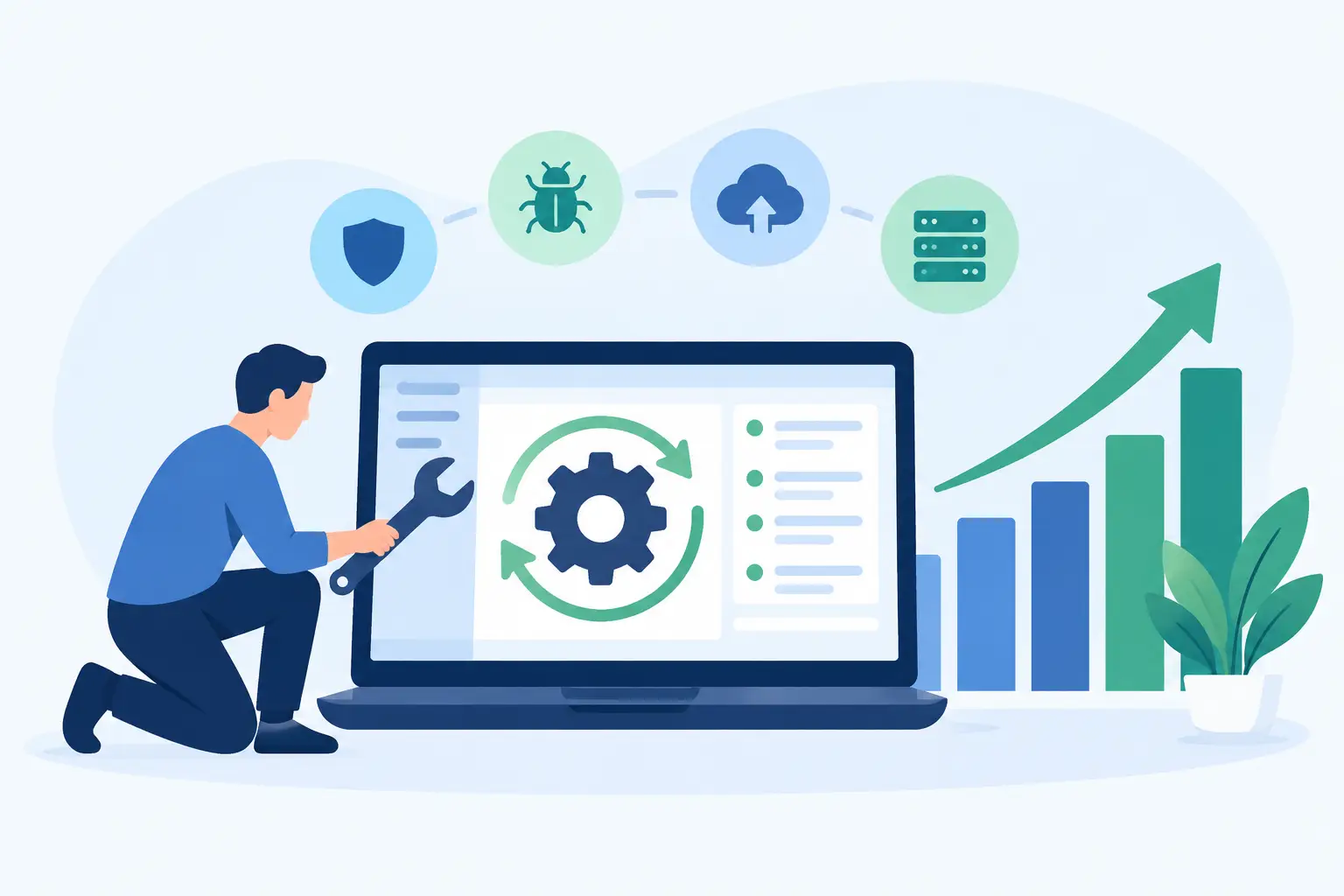
A platform can launch on time, win early users, and still become a business risk six months later. A critical dependency reaches end of life. Mobile operating systems change. A payment workflow breaks after a third-party update. A small performance issue becomes a support queue full of frustrated customers.
That is why software maintenance services are not an afterthought to development. They are the operating discipline that keeps your application secure, usable, and aligned with the way your business actually works as it grows.
For founders, product leaders, and operations teams, the question is not whether software will need attention after release. It will. The real question is whether you have a team that can respond with context, technical ownership, and a clear process before small issues become expensive interruptions.
What Software Maintenance Services Should Cover
Maintenance is often mistaken for bug fixing. Bug fixes matter, but they are only one part of keeping a production system healthy. A capable maintenance engagement protects the technology foundation while making room for the changes that users, regulations, and business priorities demand.
At the minimum, the work should include monitoring and resolving defects, applying security patches, updating frameworks and libraries, and maintaining compatibility with browsers, devices, operating systems, and external integrations. It should also include performance checks, database health, backup validation, and support for production incidents.
The stronger engagements go further. They create a reliable path for change requests, feature enhancements, UX improvements, and technical refinements that reduce future delivery risk. This matters when an internal workflow evolves, a healthcare platform needs new permissions, or an EdTech product adds reporting requirements for enterprise customers.
A maintenance team should be able to explain what happened, what was fixed, what remains at risk, and what should be prioritized next. Fast response without visibility may solve a ticket, but it does not give decision-makers confidence in the platform behind it.
Corrective, preventive, and adaptive work
Corrective maintenance addresses defects that already affect users or operations. Examples include an inaccurate calculation, failed notification, broken checkout flow, or mobile crash. These issues require prompt triage because they have a direct cost in lost revenue, wasted staff time, or damaged trust.
Preventive maintenance reduces the chance of future failure. The team may remove fragile code, strengthen test coverage, address known security vulnerabilities, improve logs, or resolve technical debt in a high-risk part of the application. It can feel less urgent than a visible bug, but postponing it indefinitely is how maintenance costs compound.
Adaptive maintenance keeps software functioning as its environment changes. An API provider modifies its authentication process, a cloud service changes a configuration requirement, or a new browser version affects a customer portal. None of these changes come from your product roadmap, yet they can disrupt operations if nobody is accountable for managing them.
Finally, perfective maintenance improves the product based on real usage. It may involve shortening a multistep approval process, reducing page load time, making a dashboard easier to read, or adding an automation that removes manual work. This is where maintenance becomes a practical source of business improvement rather than a cost center.
When Your Business Needs Software Maintenance Services
Every product needs maintenance, but the required level depends on the application’s importance, complexity, and rate of change. A small internal tool with limited users may need scheduled support and occasional updates. A customer-facing marketplace, learning platform, healthcare application, or supply chain system needs a more structured operating model.
Warning signs are usually visible before a major failure. Releases take longer because nobody understands the existing code. Teams rely on spreadsheets or manual workarounds when a feature fails. Support requests repeat without a permanent fix. Security updates are postponed because the original developers are unavailable. These are not just technical problems. They are signals that software is no longer supporting the pace of the business.
Maintenance is particularly valuable after an MVP proves market demand. Early-stage products are built for speed, which is often the right decision. Once customers rely on the platform, however, the focus must expand from launching features to stabilizing the architecture, strengthening quality assurance, and making future releases more predictable.
For enterprises, the issue is often legacy complexity rather than startup speed. Core workflows may depend on older systems, undocumented integrations, or a vendor relationship that no longer provides enough responsiveness. A maintenance partner can assess the codebase, identify immediate exposure, and establish a practical modernization plan without forcing a risky full rebuild.
A Better Operating Model for Post-Launch Support
Good maintenance begins with discovery. Before committing to service levels or release schedules, the delivery team needs access to the codebase, infrastructure, documentation, analytics, support history, and third-party integrations. This initial assessment identifies dependencies, security exposure, deployment gaps, and areas where knowledge is concentrated in one person or team.
From there, define how work enters the system. Production incidents need a clear escalation path. Routine defects require prioritization based on user impact and business value. Change requests should be estimated transparently, with acceptance criteria that prevent confusion once development begins.
A predictable release process is equally important. Small, tested releases are usually safer than waiting for a large collection of changes. That does not mean every business needs daily deployment. It means the release cadence should match the product’s risk profile, customer expectations, and internal approval process.
For systems with high operational stakes, service reporting should cover more than completed tickets. Leaders need visibility into open risks, recurring defects, response performance, planned updates, and recommendations for the next period. This converts technical activity into information that supports budget and product decisions.
What to Expect From a Maintenance Partner
The right partner brings more than available developers. They take ownership of the outcome while communicating in a way that allows both technical and nontechnical stakeholders to make decisions quickly.
Look for a team that can work across the full application stack, including web or mobile interfaces, backend services, databases, cloud infrastructure, QA, and integrations. A narrow resource may be useful for a specific task, but fragmented responsibility creates delays when an issue crosses multiple layers of the product.
You should also expect disciplined quality practices. Every fix does not require an oversized process, but changes should be reviewed, tested, and documented at the level appropriate to the risk. For example, a text update and a change to payment authorization should not follow the same testing path.
Communication is part of the service itself. A dependable partner sets expectations early, reports progress consistently, raises risks before deadlines are affected, and explains trade-offs in business language. If an urgent fix will create future technical debt, you should know that before approving the shortcut.
Commercial flexibility also matters. Time-and-materials support can work well when priorities change frequently. A dedicated development team is often a better fit when the application needs ongoing feature delivery alongside maintenance. The right model depends on the volume and predictability of work, not on a one-size-fits-all contract.
Turning Maintenance Into Product Momentum
The most effective maintenance programs do not spend every month reacting. They reserve capacity for improvements that make the product easier to operate, support, and scale. That could mean automating repetitive admin tasks, improving API reliability, upgrading an outdated framework, or refining a mobile experience based on user feedback.
This requires balance. If every hour is reserved for future improvements, urgent issues wait too long. If every hour is consumed by emergency work, the underlying causes never get resolved. A practical backlog separates incidents, planned maintenance, technical debt, and business enhancements so leaders can make deliberate trade-offs.
At Xornor Technologies, post-launch support is treated as an extension of product delivery, not a handoff after deployment. The goal is to maintain reliable software while giving businesses a responsive engineering team for the next feature, workflow change, or growth milestone.
Your software should not become harder to change as your business becomes more ambitious. With clear ownership, visible priorities, and consistent engineering attention, maintenance becomes the foundation for the release your customers need next. Get in touch to build that foundation before the next issue sets your roadmap for you.