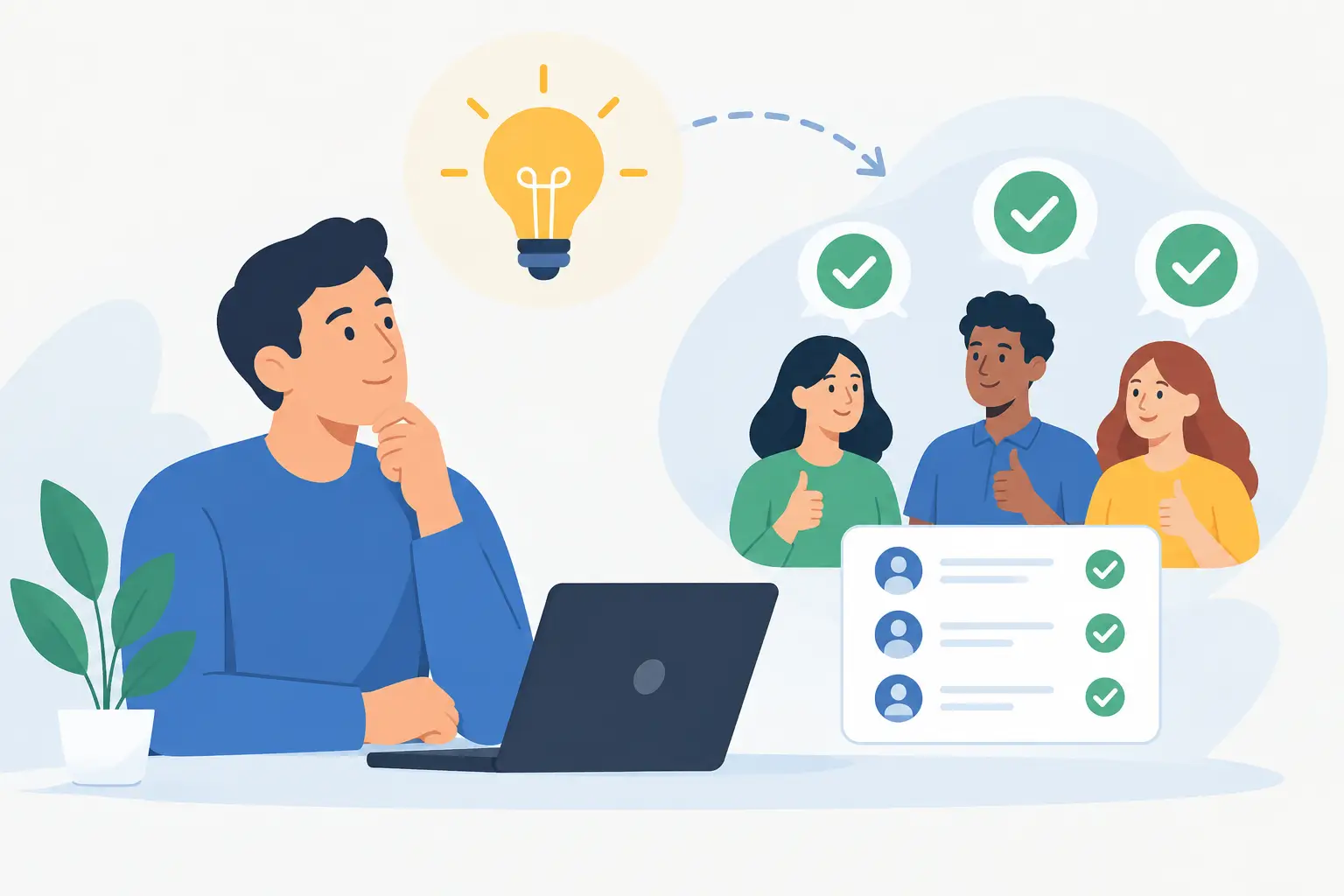
A polished application built for the wrong problem is still a failed investment. The hardest part of validating product ideas is not collecting opinions. It is separating polite interest from evidence that customers will change behavior, spend money, or bring the product into an existing workflow.
For founders and business leaders, that distinction can prevent months of development effort from going into a feature set nobody truly needs. For enterprise teams, it can stop another internal platform from adding complexity instead of removing it. Validation is not a delay before building. Done properly, it is how you build with direction.
Start With the Business Problem, Not the Feature List
Many product concepts begin with a solution: an AI assistant, a marketplace, a mobile app, a learning portal, or a workflow dashboard. Those ideas may be viable, but the technology does not prove the business case. Start by stating the problem in clear operational terms.
A useful problem statement identifies who experiences the issue, when it occurs, what they do today, and what it costs them. For example, “Operations managers lose two days each week reconciling shipment updates across spreadsheets, emails, and carrier portals” is more actionable than “We need a supply chain dashboard.”
This level of clarity changes the questions you ask. Rather than asking prospects whether they like a dashboard concept, ask how they currently reconcile information, where mistakes occur, how long the process takes, and what happens when a shipment status is wrong. Details about workarounds, delays, lost revenue, compliance risk, and customer complaints are signals of a real problem.
There is a trade-off here. A broad problem can represent a large market, but it is difficult to validate and even harder to solve in an initial release. A narrow problem may have a smaller immediate audience, yet it gives the team a clear user, measurable outcome, and focused MVP scope. Early products usually benefit from focus.
Define a Testable Product Hypothesis
A product idea becomes testable when it is written as a hypothesis rather than a promise. A practical format is: “We believe [specific customer] will use or pay for [solution] because it helps them achieve [measurable outcome].”
For a healthcare provider, that might mean reducing missed appointments. For an EdTech business, it could mean helping training managers identify struggling learners before they fail a certification. For a digital commerce company, it may be reducing abandoned orders caused by a slow, confusing checkout experience.
Add the assumptions underneath the hypothesis. These typically include the customer segment, urgency of the pain, willingness to change current behavior, purchasing process, pricing tolerance, and technical feasibility. Not every assumption carries equal risk. If customers already acknowledge the problem but you are unsure whether your proposed workflow will work, prototype testing should come first. If you are unsure whether the problem matters at all, customer discovery comes before design or development.
A disciplined team prioritizes the assumptions that could make the entire product unworkable. There is little value in debating secondary features while the core buyer, problem, or economic model remains unproven.
Use Customer Conversations to Find Evidence
Customer interviews are most valuable when they explore past behavior rather than hypothetical future behavior. “Would you use this?” invites a friendly answer. “Tell me about the last time this happened” produces evidence.
Speak with people who match the expected buyer or end user. If a department head signs the contract but employees use the system daily, interview both groups. The buyer may care about cost, reporting, risk reduction, and implementation effort. The user may care about speed, clarity, and whether the new process creates more work. A product that serves only one side can struggle after purchase.
Ask open questions about the existing process, previous attempts to solve the issue, budget decisions, tools currently in use, and the consequences of leaving the problem unresolved. Listen for specific language customers repeat. That language can shape product positioning, onboarding, and sales conversations later.
Do not treat interview volume as proof by itself. Ten interviews with vague enthusiasm are weaker than three conversations in which decision-makers describe a recurring, expensive problem and agree to a next step. Strong signals include sharing internal data, introducing you to a stakeholder, requesting a demo, joining a pilot, or discussing pricing and procurement.
Test Demand Before Building the Full Product
Validation should move from low-cost tests to higher-commitment tests. The right method depends on the product, the customer, and the risks involved.
For a B2B platform, a clickable prototype and a structured demo can test whether the workflow makes sense. A landing page with a focused value proposition can test message-market fit and capture qualified interest. A concierge pilot, where your team delivers part of the service manually, can reveal whether customers value the outcome before automation is built. In some cases, a paid design partner agreement is the strongest early signal because it confirms priority, access, and commercial intent.
Consumer products may benefit from demand tests using targeted campaigns, waitlists, preorders, or limited beta access. However, traffic alone is not validation. A high click-through rate with no sign-ups, repeat usage, or purchase intent often means the message is interesting but the offer is not compelling enough.
Enterprise software requires additional care. Security reviews, integrations, legal requirements, data migration, and change management can influence adoption as much as the interface. If a product depends on connecting to an ERP, LMS, CRM, or clinical system, validate that integration path early. A technically impressive MVP is not commercially useful if it cannot operate within the customer’s environment.
Build an MVP Around One Critical Outcome
An MVP is not a smaller version of every feature on the roadmap. It is the minimum product experience that proves the customer can achieve the primary outcome. That may be one automated approval flow, one learner analytics view, one patient intake journey, or one vendor onboarding process.
The temptation to build more is understandable. Teams want a professional launch, stakeholders want their requests included, and competitors may appear to offer a long list of capabilities. Yet feature-heavy first releases make it harder to learn what created value. They also increase delivery risk, QA effort, and post-launch support requirements.
A focused MVP should answer a few business-critical questions: Can users complete the core task? Do they return? Does the product reduce time, errors, cost, or friction? Will the intended buyer pay to continue using it? The metrics should reflect the product’s purpose, not vanity numbers. A thousand registrations mean little if users never complete the workflow that matters.
This is where dependable engineering execution matters. A prototype may validate the workflow, but a production MVP must also protect data, perform reliably, and provide a maintainable foundation for the next release. The architecture should support expected growth without overengineering for scale that has not yet been earned.
Decide What the Results Mean
Validation is not a pass-or-fail ceremony. It is a decision process. After each test, review the evidence against the original assumptions and decide whether to proceed, refine the approach, narrow the segment, change the offer, or stop.
A weak result does not always mean the idea is wrong. It may mean the target audience was too broad, the message emphasized the wrong benefit, the prototype failed to explain the workflow, or the price did not match perceived value. On the other hand, repeatedly explaining away a lack of demand is how teams drift into expensive product bets.
Set decision thresholds before reviewing results. For example, a pilot may require a defined activation rate, a percentage improvement in processing time, and agreement from a sponsor to continue into a paid phase. Predefined thresholds reduce the risk of interpreting every outcome optimistically after substantial effort has already been invested.
Turn Learning Into a Delivery Plan
Once the evidence supports moving forward, convert what you learned into a practical product plan. Document the validated user problem, target segment, core workflow, technical constraints, metrics, and features deliberately excluded from the first release. This provides a stronger foundation for requirements, UX design, architecture, estimation, and development milestones.
At Xornor Technologies, this is the point where product strategy becomes build-ready execution: translating business requirements into a focused MVP, selecting the right technology approach, and creating a release plan that supports feedback after launch. The best validation work does not end when development begins. It continues through real usage, support requests, analytics, and customer conversations.
Your next product does not need more assumptions. It needs the smallest credible test that can produce a useful decision. Get that evidence early, then build the part that customers have shown they need.