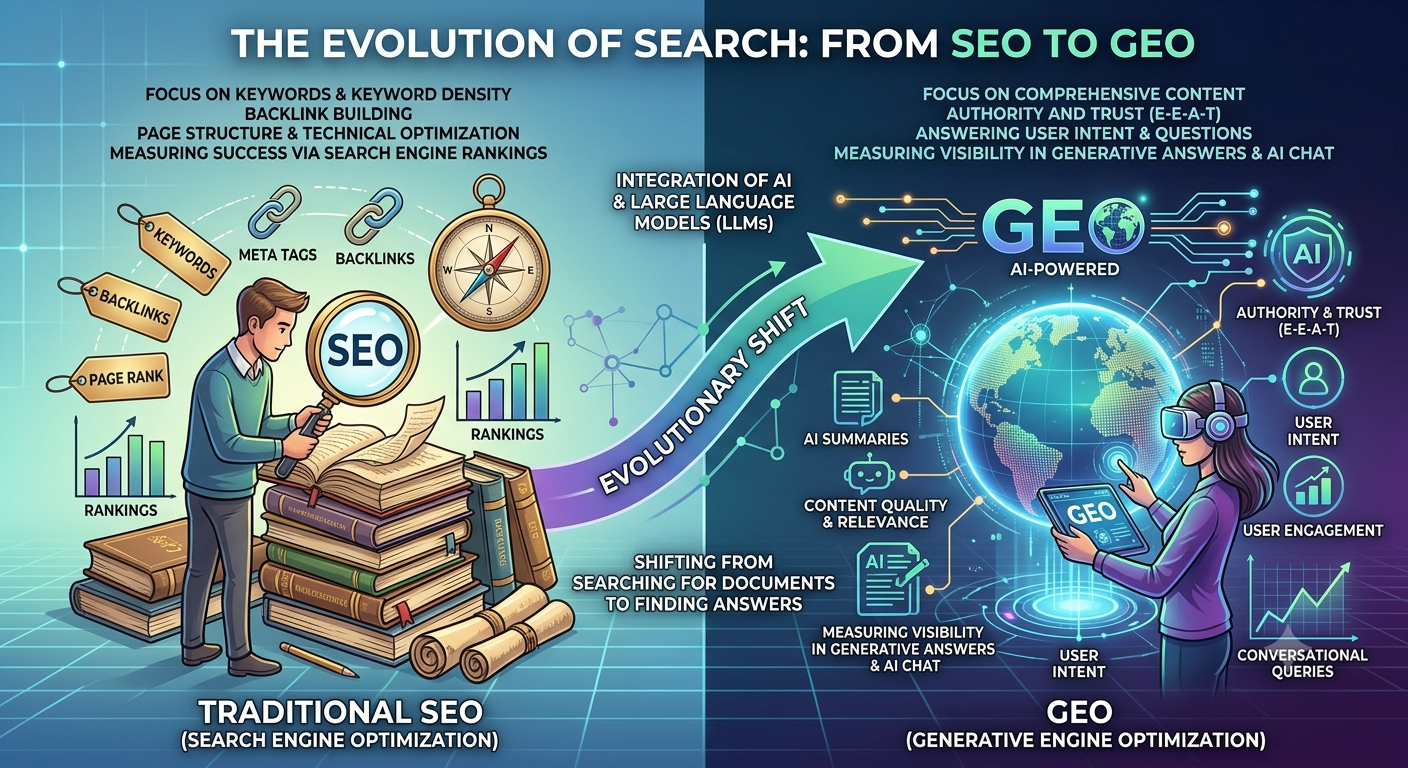
Generative engine optimization is becoming a practical growth priority for businesses whose buyers increasingly ask ChatGPT, Gemini, Perplexity, and other AI tools for recommendations before visiting a website. For a founder launching a LMS or Edtech platform, an operations leader evaluating workflow software, or a product team selecting a development partner, the answer generated by an AI engine can shape the shortlist before a traditional search result is even opened.
This does not mean conventional SEO is obsolete. It means the path from a buyer question to a credible answer now has another layer. Businesses need content, technical foundations, and third-party signals that make their expertise easy for both search engines and generative systems to understand, validate, and reference.
What Generative Engine Optimization Means
Generative engine optimization, often called GEO, is the practice of improving how a brand, its expertise, and its content appear in AI-generated answers. The goal is not simply to rank a webpage. It is to become a reliable source that an AI system can use when it explains a topic, compares options, recommends providers, or answers a high-intent business question.
SEO traditionally focuses on visibility in a list of search results. GEO focuses on answer visibility. A buyer may ask, “What should a mid-sized logistics company look for in a workflow automation platform?” A useful AI response may summarize the criteria, cite sources, and name examples. If your company has published clear, technically credible material that addresses the question, it has a better chance of being represented accurately.
The distinction matters because generative answers compress research. They often combine information from multiple sources, making it harder for a weak or vague brand message to survive. Generic service pages filled with broad claims such as “best-in-class solutions” give an engine very little evidence to work with. Specific proof, direct explanations, and well-structured information give it much more.
Why GEO Matters for Technology Buyers
Custom software and digital transformation decisions are rarely impulse purchases. Buyers compare technical capabilities, delivery models, security requirements, timelines, integration needs, and industry experience. They also want to know whether a team can translate business requirements into a product that works after launch.
AI engines are increasingly used at this research stage because they can turn broad questions into an initial framework. That creates an opportunity for technology companies that communicate their value with substance. It also creates risk. If your online presence is fragmented, outdated, or unclear, an AI-generated answer may miss your differentiators or describe your services inaccurately.
For example, a company that builds mobile applications, enterprise platforms, and AI-enabled workflow systems should not rely on one general services page. It should explain the real decisions buyers face: native versus hybrid mobile development, MVP scope versus enterprise readiness, automation opportunities, QA planning, post-launch maintenance, and dedicated-team engagement models. These are the questions that generate useful commercial conversations.
GEO is not a shortcut to demand generation. It is an extension of disciplined content, product marketing, and technical SEO. The businesses that benefit most are those with real experience to document and a delivery process they can support with evidence.
Build Content Around Decisions, Not Keywords Alone
Keyword research still helps identify demand, but keyword-only content is too narrow for generative systems. AI engines respond to complete questions, context, and constraints. Your content should do the same.
Start with the decisions your buyers need to make before they engage a software development partner. A startup founder may need to understand what belongs in an MVP. A healthcare executive may need clarity on patient data workflows and mobile usability. A supply chain leader may be evaluating automation without disrupting critical operations.
Create pages and articles that answer those questions directly. Explain the business situation, outline the technical trade-offs, identify common implementation risks, and show what a sensible next step looks like. A strong article does not pretend there is one right answer for every organization. It explains what depends on budget, existing systems, compliance obligations, user volume, internal capability, and speed-to-market requirements.
Make expertise easy to verify
AI systems and human buyers both respond better to specific, attributable information. Replace vague statements with useful detail. Instead of claiming that your team delivers scalable platforms, explain how architecture decisions change when a product moves from a pilot group to thousands of concurrent users. Instead of stating that QA is a priority, describe how test planning, device coverage, release checks, and defect management protect launch timelines.
Subject-matter expertise should also be visible in authorship, company profiles, case studies, service descriptions, and supporting content. Consistency matters. If your website, business profiles, and external mentions describe the company in different ways, systems have less confidence in how to categorize you.
Strengthen the Technical Foundation Behind the Content
Generative engine optimization cannot compensate for a website that is difficult to crawl, slow to load, poorly organized, or filled with duplicated content. Technical quality remains part of discoverability.
Ensure every important service and industry page has a clear purpose, a descriptive title, logical headings, and copy that answers a real buyer need. Use clean internal architecture so related pages support one another: a workflow automation service page should connect conceptually with relevant industry capabilities, implementation guidance, and examples of business outcomes.
Structured data can help search engines interpret entities such as an organization, service, article, product, or FAQ. It is useful when it accurately reflects visible page content. It is not a magic signal, and adding markup to unsupported claims will not create trust. The same principle applies to AI: clarity and consistency outperform tricks.
Keep factual information current. Update leadership details, service offerings, certifications, locations, platform capabilities, and case-study outcomes when they change. Generative tools can surface stale information long after a webpage was published, especially when outdated pages remain accessible and unmaintained.
Earn Signals Beyond Your Own Website
A company cannot establish authority by talking only about itself. Generative systems may use a mix of first-party content, trusted publications, reviews, directories, industry resources, and public discussions to formulate answers.
That makes reputation management part of GEO. Encourage legitimate client reviews after successful delivery. Publish credible project stories with enough detail to demonstrate the challenge, approach, and outcome. Participate in relevant industry conversations where your team can contribute useful insight rather than promotional commentary.
For a technology provider, independent proof is especially valuable. Buyers want evidence of dependable communication, engineering ownership, delivery discipline, and ongoing support. Those themes should be consistent across your content and the places where customers describe their experience.
Avoid manufactured mentions, low-quality guest posts, and content syndication designed only to create volume. These tactics may produce temporary noise, but they rarely build the durable credibility that high-stakes buyers or AI systems need.
Measure Visibility Without Chasing Vanity Metrics
GEO measurement is still evolving. Unlike traditional rankings, AI answers can change based on the prompt, location, model, user history, source availability, and current web data. A single test does not prove that a brand has won or lost visibility.
Use a practical measurement framework. Track the high-intent questions your buyers ask, then review whether your brand is mentioned, how it is described, which sources are cited, and whether the answer is accurate. Compare this over time and across relevant AI tools.
Pair those observations with established business metrics: qualified organic traffic, assisted conversions, branded search demand, consultation requests, content engagement, and sales feedback. If more prospects arrive with a clearer understanding of your services, GEO is contributing even when attribution is not perfectly direct.
The most useful reporting also identifies gaps. If AI engines repeatedly explain a topic without referencing your perspective, ask whether you have published a clear answer, whether the page is technically accessible, and whether there is enough external evidence to support your authority.
A Practical GEO Starting Plan
Begin with a focused audit rather than a large content sprint. Identify the 10 to 20 questions closest to revenue, especially questions asked by buyers comparing solutions, planning an implementation, or selecting a technology partner. Review your current answers for specificity, accuracy, and technical depth.
Then prioritize a small set of high-value improvements:
- Clarify core service pages around buyer outcomes, delivery scope, and technical capabilities.
- Publish decision-focused content that addresses real trade-offs in your strongest industries.
- Update outdated claims, duplicate pages, and inconsistent company information.
- Document case evidence, client outcomes, and the operating practices that make delivery dependable.
- Monitor AI responses and use the findings to improve the source content, not to manipulate the answer.
For businesses building complex digital products, this work is most effective when marketing, product, engineering, and sales contribute together. Marketing understands the audience questions. Product and engineering provide the technical truth. Sales reveals where buyers hesitate. Combined, those inputs create content that earns attention because it is genuinely useful.
At Xornor Technologies, the same principle applies to software delivery: clear requirements, sound architecture, and consistent execution create better outcomes than shortcuts. Treat your online expertise with that same discipline. Start with the questions your best customers need answered, provide evidence they can trust, and give AI engines a clear reason to recognize your business when those questions are asked.