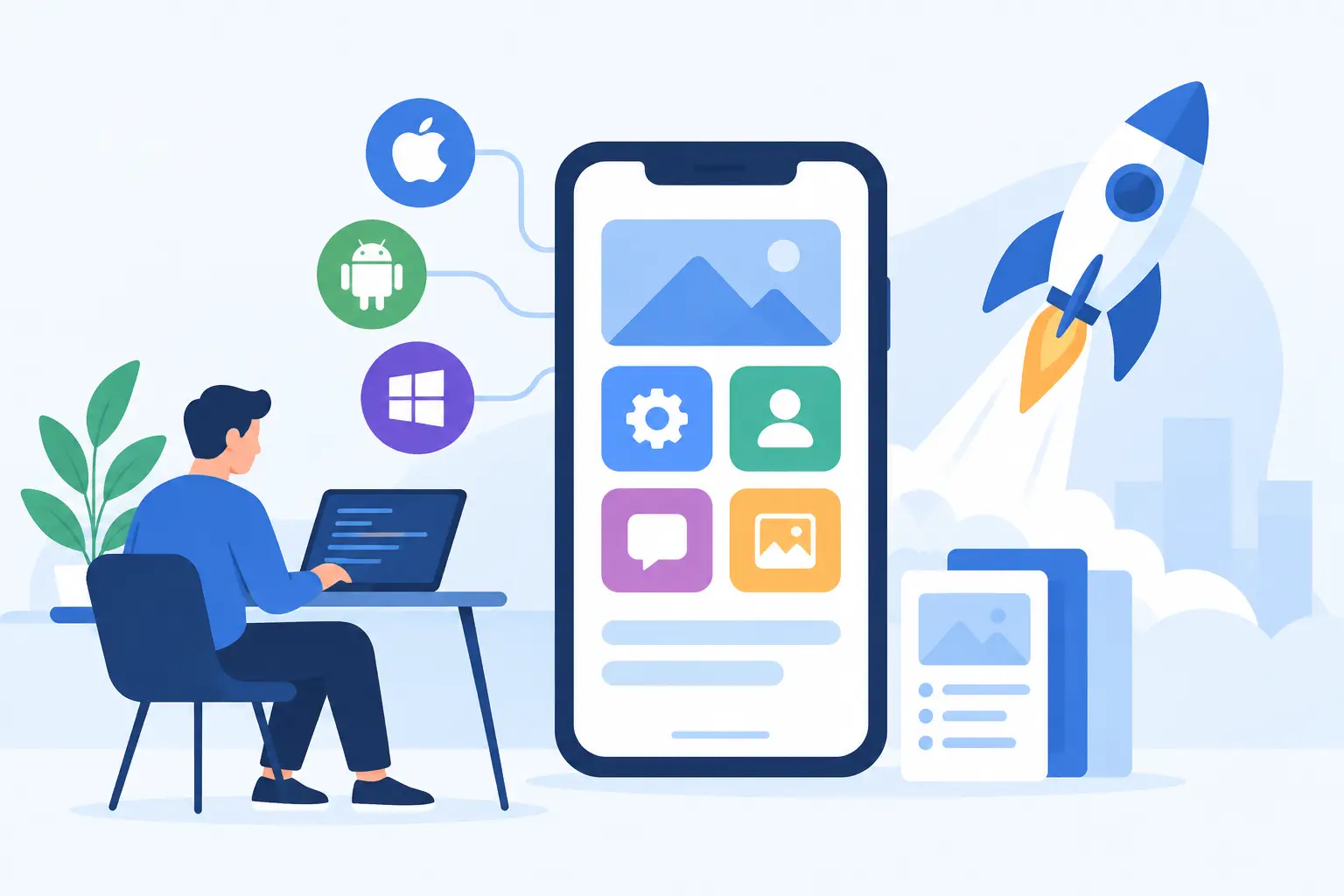
A customer downloads your app because they need to book an appointment, complete a course, manage an order, or approve work in the field. They do not care whether the code began as one mobile codebase or two. They care that the experience is fast, reliable, and consistent on the device in their hand. That is why hybrid app development is often a practical choice for businesses that need to reach iOS and Android users without doubling every early product decision.
For founders and operations leaders, the question is not whether hybrid is fashionable. The real question is whether it supports the product roadmap, device requirements, integrations, budget, and launch timeline. A well-planned hybrid application can shorten time to market while maintaining the quality expected from a business-critical mobile product. A poorly planned one can create performance issues that appear only after customers and internal teams depend on it.
What hybrid app development means for your business
Hybrid app development uses a shared codebase to create applications for multiple mobile platforms, usually iOS and Android. Modern frameworks such as Flutter and React Native render native interface components or compile into performant mobile applications, while allowing development teams to reuse much of the application logic, user interface, and integrations.
This is different from a mobile website wrapped in an app shell. A business-grade hybrid application can use device features such as cameras, push notifications, biometric login, location services, local storage, and payment capabilities. It can also connect securely with your CRM, ERP, learning management system, healthcare platform, inventory tools, or custom back-office software.
The shared-code approach matters most when your product needs broad market coverage early. Instead of building one app for iOS and then funding a separate Android build, teams can prioritize product validation, workflow design, and user feedback across both platforms at the same time.
When a hybrid approach creates a real advantage
Hybrid is a strong fit when the core customer journey is similar across devices and the business needs a dependable release process. Consider an EdTech company launching student learning, assessments, progress tracking, and notifications. Or a supply chain business giving drivers access to delivery tasks, proof-of-delivery photos, and status updates. In both cases, a shared mobile foundation can keep the experience consistent while reducing duplicated engineering work.
It is also effective for startups building an MVP. Early-stage teams need evidence that customers will adopt the product before committing to a large platform-specific engineering investment. Hybrid development can help bring a focused version to market sooner, provided the MVP is not overloaded with features that should wait until user behavior is proven.
For established enterprises, the value can be operational as much as commercial. A hybrid app can bring fragmented workflows into one mobile experience: service requests, approvals, field updates, internal learning, document access, and customer communication. Employees spend less time moving between spreadsheets, calls, and disconnected tools. Leaders gain clearer data on where work stalls.
Cost efficiency is a benefit, but it should not be the only reason to choose hybrid. The greater value comes from concentrating effort on the parts that differentiate your business: workflow logic, integrations, usability, security, and release quality.
Where hybrid app development needs careful evaluation
A shared codebase does not remove the need for engineering judgment. iOS and Android have different design expectations, operating system behaviors, app store requirements, and device ecosystems. A capable team plans for those differences instead of assuming every screen and feature will behave identically.
Hybrid may not be the best first choice for highly graphics-intensive games, advanced real-time 3D experiences, or applications that depend on deeply specialized hardware features. It can still be possible, but the technical complexity may reduce the economic advantage of code sharing. In those cases, native development or a mixed architecture may offer better control.
Performance should also be evaluated in the context of the product. A customer portal, learning platform, commerce app, or field-service workflow may perform extremely well with Flutter or React Native. An application processing constant high-volume sensor data or complex media editing has a different performance profile. The right decision comes from testing the most demanding user flows early, not from relying on generic framework claims.
Security is another non-negotiable area. Healthcare, financial services, education, and enterprise operations often involve sensitive information. Authentication, role-based access, API security, encrypted local storage, audit trails, and secure session management should be part of the architecture from the start. They should not be treated as final-stage additions before launch.
Start with the workflow, not the framework
Technology decisions work best when they follow clear business requirements. Before selecting a framework, define who will use the application, what outcomes they need, and what happens when a task fails or an internet connection is unavailable.
For example, a field operations app may need offline data capture, photo uploads, GPS validation, and sync logic that prevents duplicate records when a connection returns. A telehealth app may require secure scheduling, patient reminders, document handling, and controlled access by user role. These workflows determine the architecture, API requirements, and testing strategy.
A disciplined discovery phase should clarify the product scope, user roles, primary journeys, integration dependencies, compliance needs, and metrics that will define success. It should also identify what belongs in the first release and what can be scheduled after launch. This protects the timeline and prevents an MVP from becoming an unfinished enterprise platform.
Build the foundation for change
Mobile products rarely remain static after release. Customers request improvements, operating systems change, integrations evolve, and business teams discover new workflow needs. The codebase should be organized for maintainability, with clear modules, documented APIs, reusable components, and a release process that supports controlled updates.
This is especially relevant when an app connects to a custom web platform. The mobile application and backend should share a consistent data model and permissions structure. When web and mobile teams build separate interpretations of the same workflow, users encounter mismatched statuses, missing data, and support issues that damage trust.
Quality assurance is part of the product, not a final checkpoint
Hybrid applications need testing across real device types, screen sizes, operating system versions, network conditions, and user roles. Emulator testing is useful, but it cannot reveal every issue tied to device cameras, notifications, biometric authentication, low-memory conditions, or inconsistent connectivity.
Quality assurance should begin while features are being built. Functional testing confirms that each workflow behaves as expected. Integration testing verifies that data moves correctly between the app and connected systems. Usability testing checks whether users can complete important tasks without unnecessary friction. Performance and security testing help identify failures that are expensive to fix after public release.
App store readiness also deserves early attention. Privacy disclosures, permission explanations, screenshots, certificates, build configurations, and review requirements can affect launch timing. A reliable delivery partner manages these details as part of the release plan rather than leaving them to the final week.
Choose a delivery partner that owns the outcome
The strongest hybrid app projects combine product thinking with accountable engineering. Your development partner should be able to translate business requirements into screens, workflows, technical architecture, and measurable milestones. Clear communication matters as much as code quality, particularly when stakeholders are distributed across time zones or when internal teams must coordinate with outside developers.
Ask how the team handles scope changes, how often you will see working builds, who owns documentation, and what support looks like after launch. A vendor that only delivers a code repository can leave your business exposed when bugs, operating system updates, or new feature priorities arrive. A long-term partner plans for maintenance, monitoring, change requests, and release management.
At Xornor Technologies, hybrid mobile work is approached as part of a broader product delivery effort: requirements, user experience, architecture, development, QA, and post-launch support. That approach helps businesses avoid the common gap between a promising prototype and a production-ready application that teams can depend on.
The right mobile strategy is the one that makes it easier for customers or employees to complete meaningful work. Start with the highest-value workflow, validate it on real devices, and build the next release from evidence rather than assumptions. That is how a mobile app becomes a dependable business asset instead of another unfinished digital initiative.