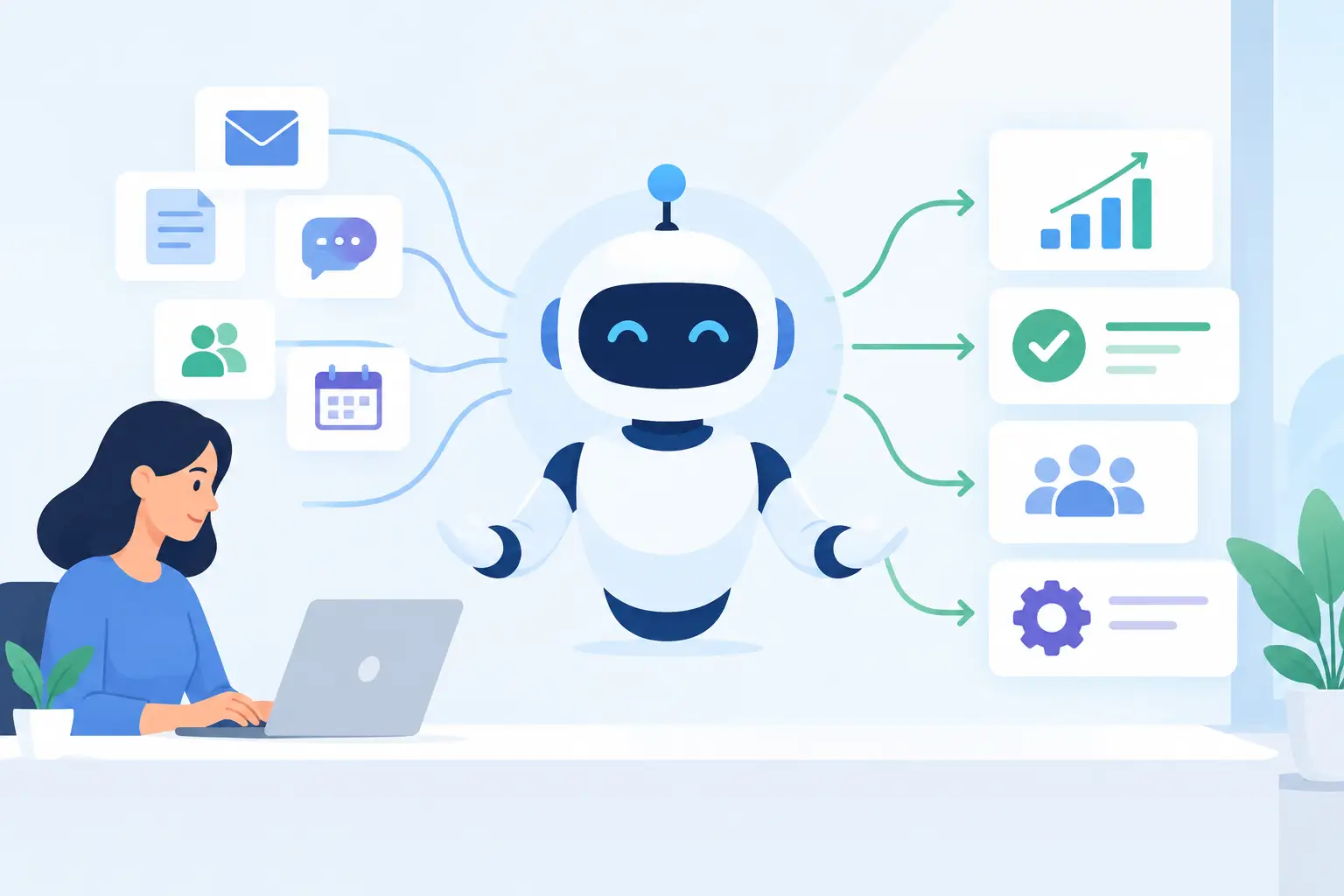
A support ticket arrives with an urgent shipping question. A person may need to check the order system, warehouse status, carrier updates, customer history, and service policy before replying. AI agents are designed to coordinate that kind of multi-step work: they can interpret a goal, use approved tools, make bounded decisions, and report what happened.
For business leaders, the appeal is clear. The opportunity is not another chatbot that produces polished text. It is software that helps teams move routine work forward across the systems they already use. But an agent is only as dependable as the workflow, data, integrations, and rules behind it. Treating it as a shortcut around product and engineering discipline creates risk. Treating it as a carefully designed operational capability can create measurable capacity.
What AI Agents Actually Do
Traditional automation follows a fixed sequence: when an invoice is received, extract fields, validate them, and route the file for approval. This is still the right approach when the process is stable and exceptions are rare.
An AI agent works differently. It receives an objective, evaluates the available context, selects from permitted actions, and adjusts when it encounters a reasonable exception. For example, an agent supporting a procurement team might identify a missing vendor detail, search the approved supplier record, request clarification if confidence is low, and prepare the purchase request for human review.
That does not mean an agent should operate without limits. In production, the useful model is controlled autonomy. The agent can retrieve information, draft a response, create a task, update a record, or recommend an action. Higher-risk actions, such as approving payments, changing medical records, issuing refunds above a threshold, or signing contracts, should require explicit authorization.
The distinction matters because language generation is only one component. A capable agentic workflow also needs access management, reliable APIs, business logic, audit trails, monitoring, and a clear fallback path when the system cannot proceed safely.
Where AI Agents Create Business Value
The strongest use cases usually begin with work that is frequent, repetitive, and spread across several systems. Teams lose time not because each individual task is difficult, but because the handoffs are slow and context is fragmented.
In customer operations, an agent can classify incoming requests, locate relevant account details, draft responses based on current policy, and route complex cases to the right specialist with a concise summary. In supply chain operations, it can monitor late shipments, identify affected orders, prepare customer communications, and create escalation tasks for exceptions.
Healthcare platforms can use agents to assist with nonclinical workflows such as appointment follow-up, intake document checks, eligibility information collection, and internal task routing. The design must account for privacy, access restrictions, and human oversight from the beginning. In EdTech, agents can help support teams organize learner questions, identify incomplete enrollment steps, and guide instructors toward students who may need attention.
For product and engineering teams, agents can also support internal delivery. They can convert approved requirements into structured tickets, flag incomplete acceptance criteria, summarize quality assurance findings, and help keep release documentation current. They should not replace experienced engineers or product owners. They can reduce the coordination overhead that prevents those people from focusing on higher-value decisions.
Value depends on the process. If a workflow is unclear, constantly changing, or dependent on judgment that has never been documented, an agent will expose that weakness rather than solve it. In those cases, process mapping and system cleanup should come before automation.
AI Agents Need an Operating Model, Not Just a Demo
A compelling demonstration can make an agent appear ready for deployment within minutes. Production is different. Enterprise workflows have incomplete data, conflicting records, permission boundaries, seasonal volume changes, and exceptions that were never included in a prototype prompt.
A practical implementation starts with one defined outcome. Rather than asking for an agent that improves operations, define a measurable job: reduce the time required to triage supplier emails, prepare first-draft responses for common support requests, or reconcile order exceptions before a daily cutoff. The target should include a baseline, an owner, and a threshold for acceptable accuracy.
Design the workflow around decisions and boundaries
The team should document what triggers the process, which systems provide trusted information, what actions the agent may take, and when it must pause. This is where business stakeholders and engineering teams need to work closely together. Operations leaders understand the exceptions. Developers can turn those rules into integrations, validation, and controlled action paths.
It is also essential to distinguish between information retrieval and decision-making. An agent may be allowed to read order data and generate a recommended response, while only a trained service representative can send a final resolution. That separation reduces exposure while still delivering speed.
Build for traceability
Every meaningful action should be visible. Teams need to know what data the agent used, what action it attempted, whether the action succeeded, and why it escalated a case. Logs should support troubleshooting, quality reviews, and compliance needs without exposing sensitive information to unauthorized users.
Traceability is not only a risk control. It improves the product. When teams review real agent runs, they find unclear policies, missing data fields, weak integrations, and recurring exceptions. Those findings can improve the underlying operation whether or not the agent remains involved.
Test exceptions before scale
Happy-path testing is not enough. Test the situations that create operational damage: duplicate customer records, an unavailable downstream API, vague requests, conflicting inventory data, outdated policy documents, and attempts to access restricted information.
A phased rollout is usually the better commercial decision. Start with a limited user group or one business unit, measure quality and time saved, then expand the scope once the controls are proven. This approach may feel slower than launching a broad automation program, but it prevents expensive rework and makes adoption easier for the people who depend on the process every day.
Common Failure Points to Avoid
The first failure point is giving an agent access to unreliable or disconnected data. If customer details differ across the CRM, billing platform, and support tool, the agent may produce a confident but incorrect answer. Data ownership and integration quality are foundational requirements, not technical details to address later.
The second is measuring activity instead of outcomes. A high number of automated interactions does not prove value if the team spends more time correcting responses or handling escalations. Measure resolution time, rework rate, escalation rate, cost per case, user satisfaction, and business-specific quality indicators.
The third is assuming the agent can compensate for a poor user experience. Customers and employees still need clear status updates, understandable escalation paths, and a way to reach a person when the situation warrants it. An agent that traps users in a loop can damage trust faster than it reduces operating costs.
Finally, avoid vendor-led pilots with no route to operational ownership. Your team needs documentation, source control, security review, monitoring responsibility, and a plan for ongoing changes. Agent behavior must evolve as policies, products, and connected systems change.
Choosing the Right Technical Approach
Not every task needs an autonomous agent. A deterministic workflow may be cheaper, faster, and easier to audit. A search-and-answer assistant may be enough when employees only need faster access to trusted documentation. An agent is most appropriate when the work requires interpreting variable inputs, choosing among approved tools, and coordinating several steps toward a defined outcome.
The architecture should match the stakes. Lower-risk internal productivity use cases can often begin with a simpler setup. Customer-facing, financial, healthcare, or compliance-sensitive workflows require stronger identity controls, data isolation, approval rules, evaluation datasets, and ongoing monitoring.
This is where a custom development partner adds practical value. Xornor Technologies helps businesses translate operational requirements into production-ready web, mobile, and platform capabilities, including the integrations and post-launch support that agentic systems require. The goal is not to add AI for its own sake. It is to deliver a dependable workflow that teams can own, measure, and improve.
Start with the process where delays are visible, decisions are repeatable, and a responsible owner can judge the result. A focused first implementation will teach your organization far more than a broad experiment, and it can build the operational confidence needed for the next one.