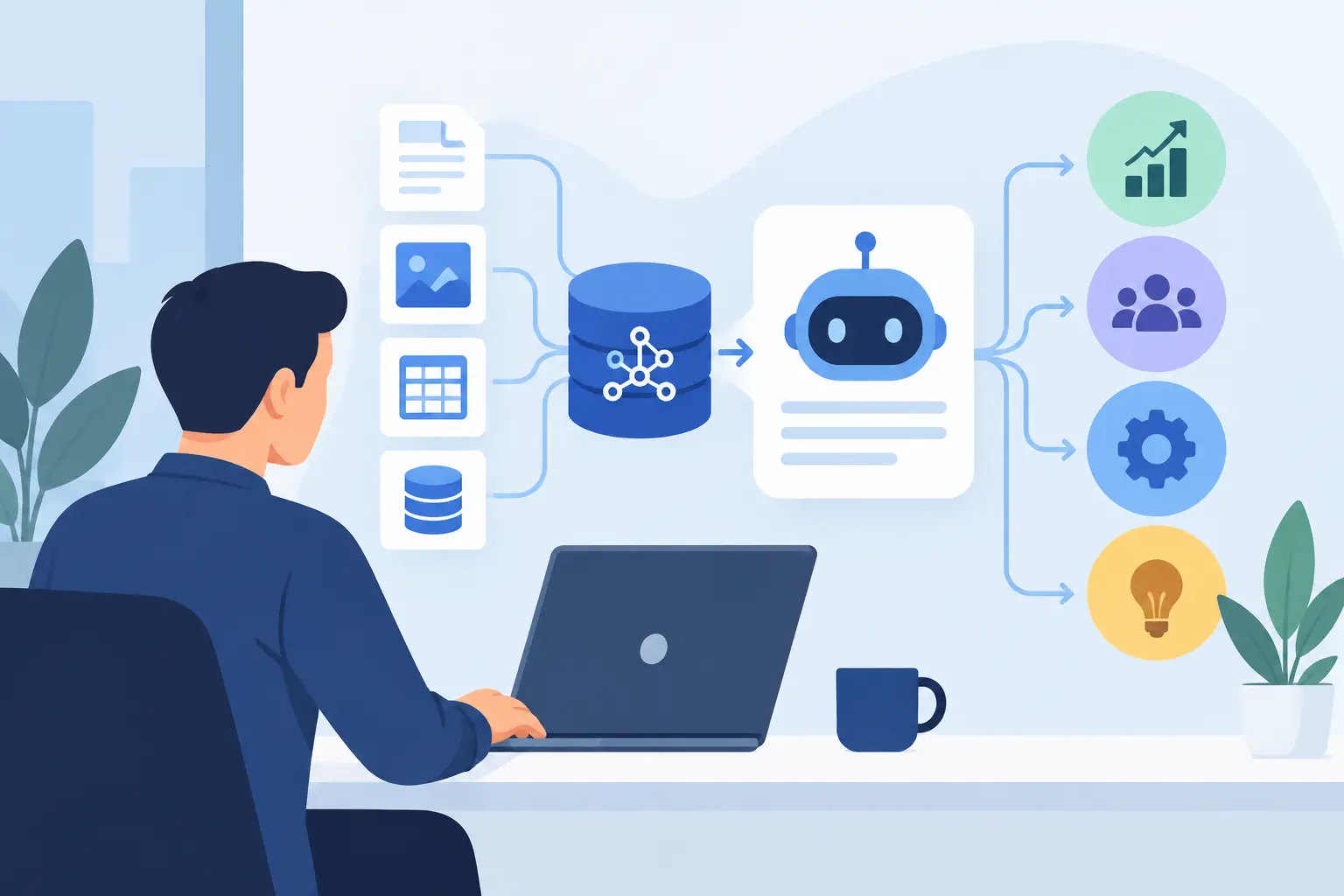
A generic AI chatbot can write a polished answer in seconds, but it cannot reliably answer, “What does our current claims policy say?” or “Which supplier contract applies to this order?” without access to the right business context. RAG development services solve that gap by connecting large language models to approved company knowledge, so users receive answers grounded in relevant, retrievable information rather than plausible guesses.
For businesses building AI-enabled platforms, internal copilots, customer support tools, or workflow systems, the opportunity is practical: reduce search time, improve self-service, and make complex information easier to use. The work, however, goes far beyond placing documents in a chatbot. A production-ready RAG system needs the right data foundation, retrieval logic, evaluation process, security controls, and user experience.
What RAG Development Services Actually Deliver
Retrieval-augmented generation, or RAG, gives an AI model access to external knowledge at the moment a user asks a question. Instead of relying only on its pre-trained knowledge, the system searches approved sources, selects relevant content, and uses that content to formulate an answer. Ideally, the response includes citations or references that help the user verify where the information came from.
RAG development services turn that concept into an operational product. Depending on your business needs, the engagement may include data discovery, document ingestion, search and retrieval design, model integration, API development, web or mobile interfaces, testing, deployment, and ongoing optimization.
The distinction matters. A proof of concept can demonstrate that an AI model can answer a few questions from a folder of PDFs. A business application must work when information changes, documents conflict, access permissions vary, users phrase questions differently, and usage grows from a pilot group to hundreds or thousands of people.
Where RAG Creates Measurable Business Value
The best RAG use cases involve information that is valuable but difficult to find, interpret, or apply consistently. In healthcare operations, staff may need controlled access to care protocols, payer guidance, and internal procedures. In EdTech, learners and instructors may need instant answers drawn from course materials, assessment rules, and program documentation. In supply chain operations, teams may need to query shipment records, SOPs, inventory policies, and vendor requirements without searching across disconnected systems.
Customer-facing support is another strong fit. A RAG-powered assistant can help customers locate product instructions, compare plans, understand account processes, or troubleshoot common issues. It should not replace human support in every situation. For sensitive cases, exceptions, or requests requiring judgment, the system should recognize its limits and route the user to the right team.
Internal knowledge assistants are often the fastest place to begin. Employees lose time switching between shared drives, ticketing systems, wikis, emails, and policy portals. A well-designed assistant can make approved knowledge searchable in natural language while retaining source-level traceability. The result is not simply faster answers. It is more consistent execution across teams.
The Architecture Behind Reliable RAG Applications
A RAG solution is only as useful as the information it retrieves. The first engineering decision is rarely the language model. It is understanding what data exists, who owns it, how often it changes, and whether it is appropriate to use for AI-assisted responses.
Start with data readiness
Business documents are rarely clean. PDFs may have poor formatting, tables may not extract correctly, and different departments may use conflicting terminology. A development team needs to normalize, classify, and segment this content before it becomes available to the system. Breaking documents into meaningful sections, often called chunking, helps the retrieval layer find the precise passage that answers a question.
Metadata is equally important. A policy document may need tags for department, region, product line, effective date, or audience. Without these details, the system may retrieve a broadly related answer when users need the one that applies to their specific situation.
Design retrieval for the real question
Keyword search alone is not enough for conversational questions. Vector search helps retrieve content based on semantic meaning, while metadata filters narrow results by factors such as user role, location, or document status. Many applications benefit from a hybrid approach that combines keyword and semantic retrieval.
The right method depends on the content. Legal-style language may require exact terminology. Technical troubleshooting may benefit from semantic matching. Product catalogs may require structured filters alongside AI-generated explanations. There is no single configuration that works for every business case.
Add guardrails before exposing the system
A production system should not treat every retrieved passage as equally trustworthy. It needs rules for source priority, answer confidence, and escalation. If no relevant source is found, the assistant should say so clearly instead of creating an answer. If information is outdated or contradictory, the system should identify the uncertainty or direct the user to a verified workflow.
Guardrails also include prompt controls, content moderation where required, rate limits, audit logging, and protections against prompt injection. These controls are especially relevant when a RAG application uses uploaded documents, supports external users, or accesses sensitive operational data.
Security and Access Control Cannot Be Added Later
Many companies want an AI assistant to search internal knowledge, but not every employee should see every record. A useful RAG application needs to respect the same permissions that govern the source systems. Finance content, patient-related information, customer accounts, personnel documents, and contract terms require role-based access and careful handling.
That means security decisions belong in the architecture from the start. The system should define how data is stored, whether it is encrypted, how user identity is verified, which sources can be indexed, and what information is recorded in logs. Enterprises may also need retention policies, regional data requirements, and human review processes.
The trade-off is clear: broader access can make an assistant more useful, but uncontrolled access creates business and compliance risk. A focused first release with a defined user group and approved data sources is often the better path.
How to Evaluate a RAG System Before Launch
RAG systems should be tested against business questions, not just technical benchmarks. A model can produce fluent language while retrieving the wrong policy, omitting a critical condition, or citing a source that does not support its answer.
Create an evaluation set from real user questions. Include straightforward requests, ambiguous phrasing, questions with no answer in the source material, and cases where access should be denied. Review whether the system retrieved the correct source, whether the answer remained faithful to that source, and whether it responded appropriately when confidence was low.
Performance matters too. Users will not adopt a tool that takes too long to respond, but speed should not come at the cost of accuracy. Teams need to balance retrieval depth, model selection, response quality, and operating cost. More retrieved context is not always better. It can introduce irrelevant details and increase latency.
Choosing the Right Delivery Approach
A successful RAG initiative begins with a focused business workflow rather than a vague goal to “add AI.” Start with a problem where the cost of searching for information is visible and the knowledge sources are available. Define the target users, the questions they need answered, the systems involved, and the outcome you want to improve.
An MVP may focus on one knowledge domain, such as onboarding documentation, support articles, or operational SOPs. Once the team validates retrieval quality, user adoption, and governance, the platform can expand to additional sources and workflows. This phased approach gives decision-makers evidence before committing to a larger rollout.
The development partner should be able to translate business requirements into a complete technical plan, not just connect an AI API. That includes product discovery, data architecture, interface design, backend integration, quality assurance, deployment, and support after launch. Xornor Technologies approaches RAG applications as part of the wider software ecosystem, ensuring the AI capability fits the workflows, platforms, and operational standards your business already depends on.
The most effective RAG solution is not the one that gives the longest answer. It is the one that helps a real user make the next correct decision with confidence. Start with that decision, define the knowledge required to support it, and build from there. Get in touch to turn your highest-value information bottleneck into a practical AI product.